
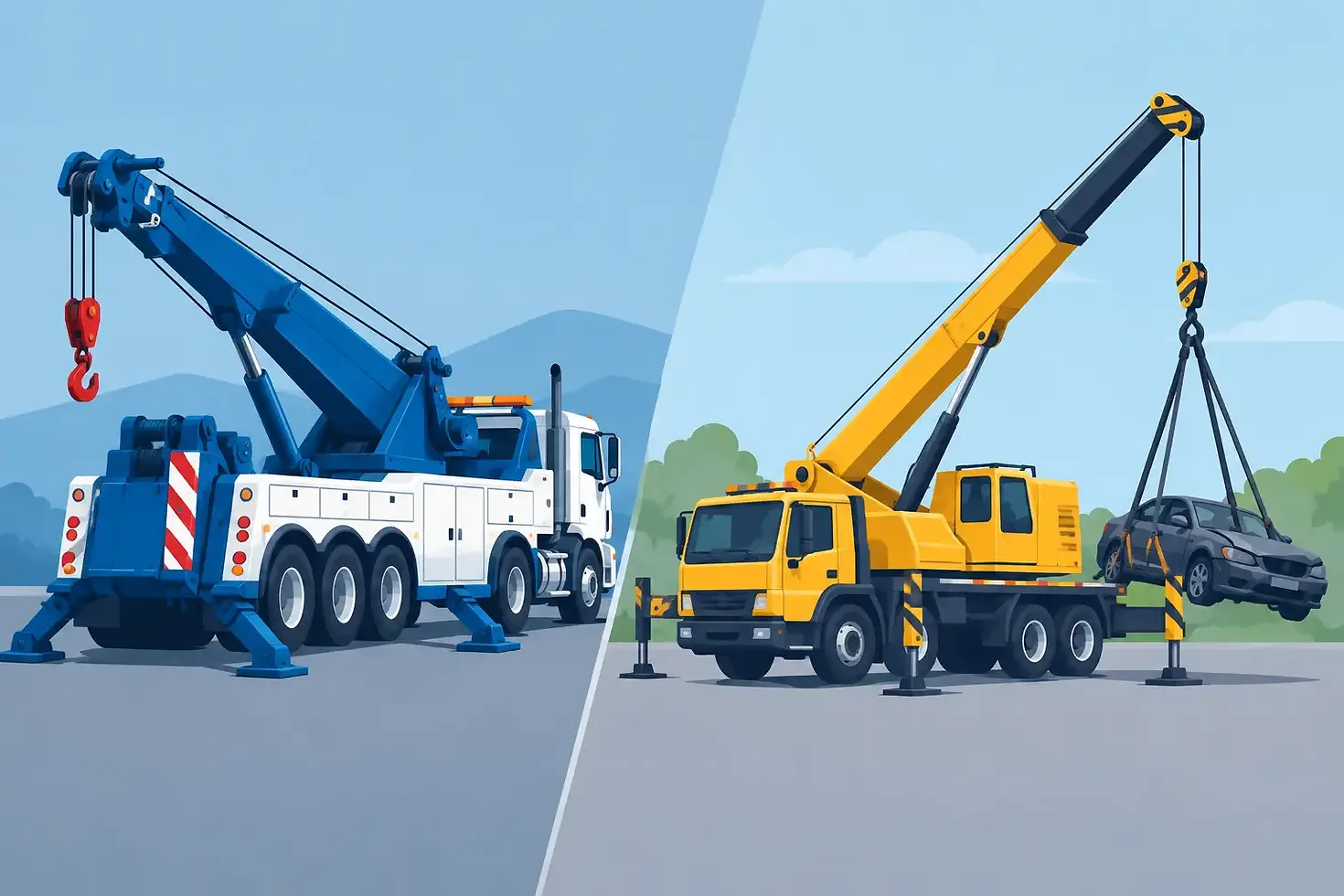
Rotator Versus Crane Recovery Explained

A loaded tractor-trailer on its side, a mixer truck leaning into a ditch, or excavator that has slipped off a jobsite access road creates one immediate question: what equipment can recover it without making the scene worse? Rotator versus crane recovery is not a matter of choosing the biggest machine available. The right choice depends on the load, ground conditions, access, traffic exposure, and how much control the recovery requires.
For fleet managers, owner-operators, and contractors, that decision affects more than the tow bill. It affects road closure time, cargo protection, worker safety, environmental exposure, and when the truck or equipment can return to service. A professional recovery crew evaluates the whole scene before committing to a lift plan.
What a Rotator Does Best
A rotator is a heavy-duty wrecker with a boom that can rotate 360 degrees. Its outriggers stabilize the unit, while its boom, winches, and rigging provide controlled lifting and pulling from positions a conventional tow truck cannot manage. In a recovery, that flexibility is often the advantage.
A rotator can work beside a disabled vehicle instead of directly in front of it. That matters on narrow shoulders, crowded roadways, bridge approaches, soft medians, and jobsite entrances where there is no clean path to line up a straight pull. The operator can rotate the boom toward the casualty, set the rigging, and lift or reposition the vehicle while remaining in a safer work area.
For many heavy highway incidents, a rotator is the practical first choice. It is designed to travel to the scene quickly, establish stability, lift a truck or piece of equipment, and transition into towing or loading if the recovery calls for it. A rotator is especially useful for overturned box trucks, buses, loaded trailers, refuse trucks, concrete vehicles, and equipment that must be carefully righted before transport.
Its winching capability also makes a difference. Recoveries are rarely one simple vertical lift. A truck may need to be held, pulled, rotated, and lowered in deliberate stages. Multiple winches give the crew control over those movements, helping prevent a shifted load, damaged frame, or sudden swing.
When Crane Recovery Makes Sense
A mobile crane is built for lifting. It may offer substantial reach, height, and lifting capacity depending on the crane type and configuration. When a vehicle or component must be lifted a long distance, raised over an obstruction, or placed precisely within a large work zone, a crane may be the better tool.
Crane recovery can be appropriate when a heavy object is far from the available roadway, down an embankment with limited wrecker access, or located inside a construction site where the lift radius demands more reach. It can also be necessary for unusually heavy machinery, large structural components, or recoveries involving a deep excavation, waterway edge, or major obstruction.
But a crane is not automatically the safer answer just because it has a larger capacity chart. It needs suitable setup space, firm ground, correct outrigger support, lift planning, and room to manage the load safely. Delivery, assembly, permitting, traffic control, and operator availability can also add time. For an urgent interstate or roadside recovery, those requirements can be significant.
A crane usually lifts. It does not replace the recovery and towing functions of a heavy-duty wrecker. Once the truck is upright or the equipment is free, another unit may still be needed to secure, tow, or transport it. That is why some complex scenes use both: a crane for the critical lift and a rotator or heavy wrecker for stabilization, recovery assistance, and transport.
Rotator Versus Crane Recovery: The Real Decision Factors
The best recovery method comes from the scene assessment, not a one-size-fits-all rule. An experienced operator considers the casualty's weight and center of gravity first. A loaded trailer can behave very differently than an empty one, and cargo that has shifted after a rollover can change the lift plan entirely.
Access is just as important. If the disabled unit is close to the travel lane, a rotator may be able to set up faster with a smaller overall footprint than a crane. If the vehicle is far from the road or behind an obstacle, the crane's reach may become the deciding factor.
Ground conditions cannot be ignored in Southwest Florida. Saturated shoulders, sand, soft grass, drainage ditches, and uneven jobsite surfaces can limit where any heavy recovery unit can safely position. Outriggers distribute load, but they do not make unstable ground safe. Crews may need mats, additional support equipment, or a different recovery angle before the lift begins.
The condition of the vehicle also matters. A truck that is upright but buried to its axles may need controlled winching rather than a vertical lift. A rolled tractor-trailer may require a coordinated upright procedure to protect the cab, trailer, and cargo. A piece of equipment resting against another object may need to be restrained from several directions before it can move.
Finally, consider the objective. Clearing a roadway fast is critical, but moving too fast without a plan can create further damage or injury. The goal is controlled clearance: protect people, prevent a secondary incident, preserve valuable equipment where possible, and reopen the area safely.
Why Capacity Numbers Alone Can Mislead
It is tempting to compare a rotator and crane by advertised tonnage. That number is only part of the picture. Lifting capacity changes with boom angle, extension, radius, ground support, rigging configuration, and the direction of force. A machine that can handle a load close to its center may not be rated for that same load at a longer reach.
The casualty weight can be uncertain, too. A commercial vehicle may carry tools, fuel, cargo, attachments, or materials that are not obvious from a quick visual inspection. The recovery crew needs accurate information whenever possible, including vehicle type, load status, cargo details, damage, and whether the unit is stable.
Rigging selection matters as much as the recovery unit. Slings, chains, spreader bars, lifting points, recovery straps, and winch lines must match the load and the planned movement. Improvised attachment points or rushed rigging can damage equipment or create a dangerous release of energy.
What to Tell Dispatch Before Help Arrives
Clear information helps send the right recovery equipment the first time. When calling for help, provide the exact location and explain whether the truck or equipment is on the road, shoulder, median, ditch, jobsite, or private property. Describe its position: upright, rolled over, jackknifed, stuck, partially submerged, or off an embankment.
Also share the make and type of vehicle or equipment, estimated weight, whether it is loaded, and what the load contains. Photos can help when they can be taken from a safe location, but no driver should enter traffic, crawl under a vehicle, or approach downed lines to get them.
If there is fuel, hydraulic fluid, cargo spillage, fire risk, injuries, or a blocked travel lane, say so immediately. Those details affect the response plan and may require coordination with law enforcement, fire rescue, environmental services, or site management.
Protect the Scene Until the Recovery Crew Takes Over
A disabled heavy vehicle creates risks long before the first recovery truck arrives. Move people out of traffic and away from the load when it is safe to do so. Use warning devices where appropriate, but do not place triangles or cones where traffic conditions make it unsafe. Keep bystanders clear, especially during an overturn or when a vehicle is resting at an angle.
Do not attempt to pull a heavy truck or machine with a pickup, another commercial vehicle, or unverified chains and straps. A failed connection can turn a difficult recovery into a serious injury event. Avoid unloading cargo, releasing brakes, or moving equipment controls unless instructed by qualified personnel who understand the recovery plan.
The right answer is not always rotator or crane alone. It may be a rotator, a crane, a heavy wrecker, support vehicles, rigging, traffic control, and a crew that knows how to sequence the work. When your truck, trailer, or equipment is down, call for professional recovery support early. YRCM Transport & Towing is available day or night to assess the situation and help get your operation moving again safely.


Comments